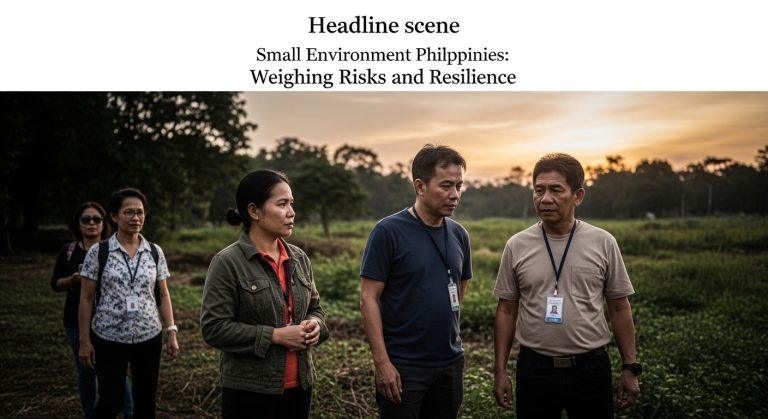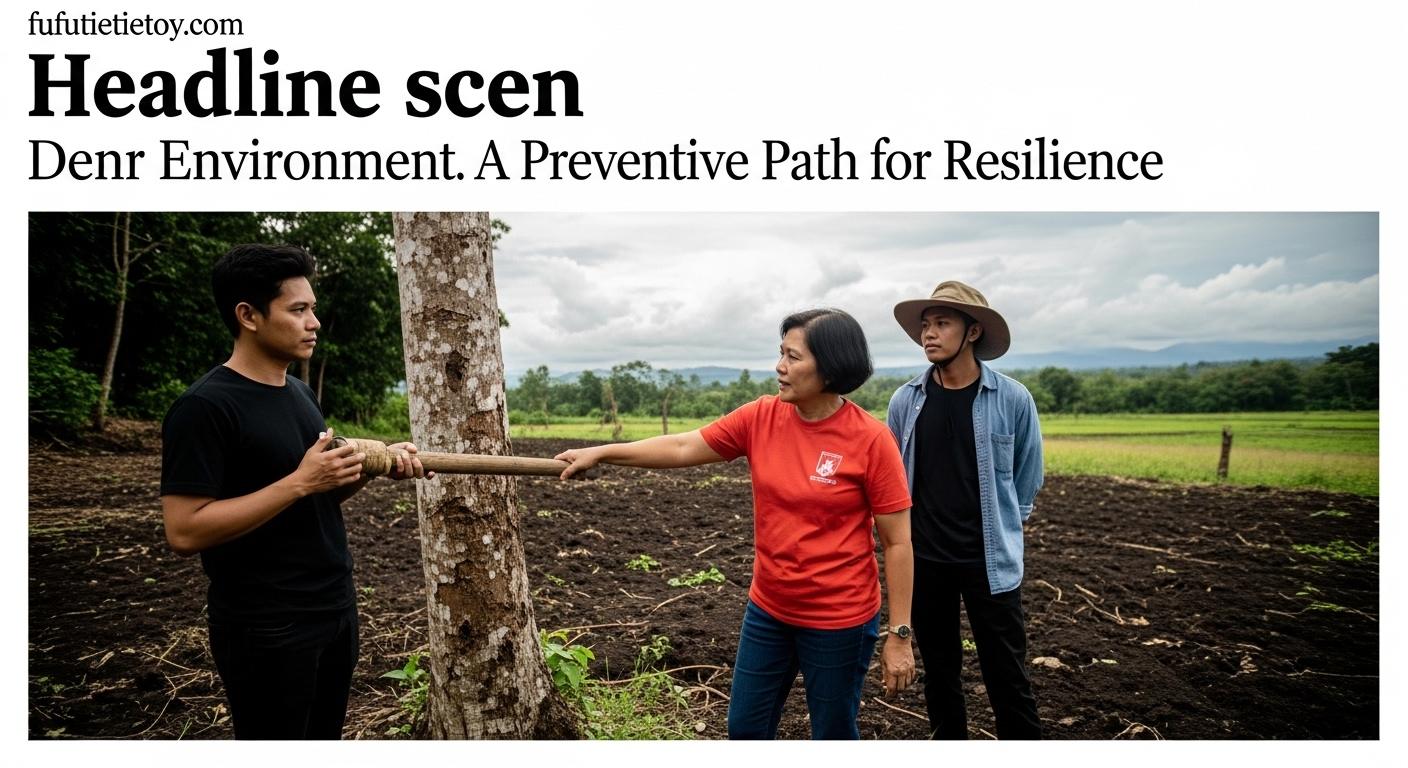
DENR officer and community volunteers at a mangrove reforestation site in the Philippines.
Updated: April 8, 2026
denr Environment Philippines has long argued that prevention is the first line of defense against climate shocks and escalating pollution. Yet the jump from policy statements to local action remains uneven across regions and municipalities. This analysis examines how a preventive governance approach, anchored in data, accountability, and community engagement, could reshape the country’s environmental resilience in an era of stronger storms and rising tides.
Framing a preventive approach in a disaster-prone nation
To understand how preventive action could work in the Philippines, it helps to map the chain from hazard to impact. When rivers swell and forests recede, risk is not only a meteorological event but a governance outcome: land-use decisions that ignore floodplains, mangrove loss that removes natural buffers, and dilapidated monitoring that misses early warning signals. A preventive frame requires integrating risk assessments into planning cycles, ensuring that data collected by the DENR and allied agencies translate into decisions at the provincial and municipal levels. It also means viewing protected areas, watershed corridors, and coastal buffers as dynamic assets rather than fixed zones. In practice, this means routine risk mapping, transparent data sharing, and procedural triggers for protective actions before storms make landfall.
Governance gaps and the financing puzzle
Even when the logic is clear, financing and capacity constraints can stall preventive programs. The archipelago’s vast geography creates command-and-control challenges for a central agency like the DENR, while local government units face competing priorities and limited technical staff. The result can be delayed reforestation, fragmented watershed management, and uneven enforcement of pollution controls. A preventive strategy, therefore, must pair predictable funding with capacity-building, performance indicators, and accountability mechanisms. This includes multi-year appropriations for forest protection, mangrove restoration, and riverbasin stewardship, as well as simplified procurement paths for field-ready tools and community-based monitoring equipment. Without stable resources and oversight, the preventive framework risks becoming aspirational rather than operational.
Policy convergence and local adaptation
Climate risk is not a single-domain problem; it intersects disaster risk reduction, urban planning, agriculture, water resources, and energy. For denr Environment Philippines to drive durable change, policy instruments must align with local realities. This means harmonizing environmental impact assessments with DRR zoning, aligning mangrove and watershed programs with flood and storm surge forecasts, and embedding ecosystem-based solutions into climate adaptation plans at the city and provincial level. It also implies clearer roles across agencies, shared data standards, and joint budgeting that incentivizes cross-sector collaboration rather than siloed mandates. When policy streams converge, communities experience faster recovery and more predictable protection of livelihoods.
Community-led resilience and knowledge systems
Beyond statutes and budgets, resilience hinges on people who live with risk every season. Community monitors, fisherfolk associations, indigenous collectives, and youth volunteers can expand the reach of official programs. The denr Environment Philippines, working with local partners, can institutionalize citizen science—engaging communities to collect water quality data, monitor forest cover changes, and report illegal dumping. When communities are co-owners of risk management, enforcement becomes more credible, adaptation becomes more affordable, and restoration projects gain social legitimacy. This is not charity; it is a practical reallocation of responsibility that builds local expertise, anchors restoration into daily life, and fosters long-run stewardship across generations.
Actionable Takeaways
- Scale and sustain mangrove and watershed restoration with multi-year funding and community co-management.
- Invest in localized risk mapping and data sharing between DENR, LGUs, and civil society to trigger preventive actions early.
- Strengthen early warning and evacuation planning by integrating natural buffers, like mangroves and coral reefs, into DRR protocols.
- Streamline cross-agency budgeting to reward preventive planning and measurable environmental outcomes.
- Expand community-based monitoring programs to improve transparency, accountability, and rapid response capacity.
Source Context and references
From an editorial perspective, separate confirmed facts from early speculation and revisit assumptions as new verified information appears.
Track official statements, compare independent outlets, and focus on what is confirmed versus what remains under investigation.
For practical decisions, evaluate near-term risk, likely scenarios, and timing before reacting to fast-moving headlines.