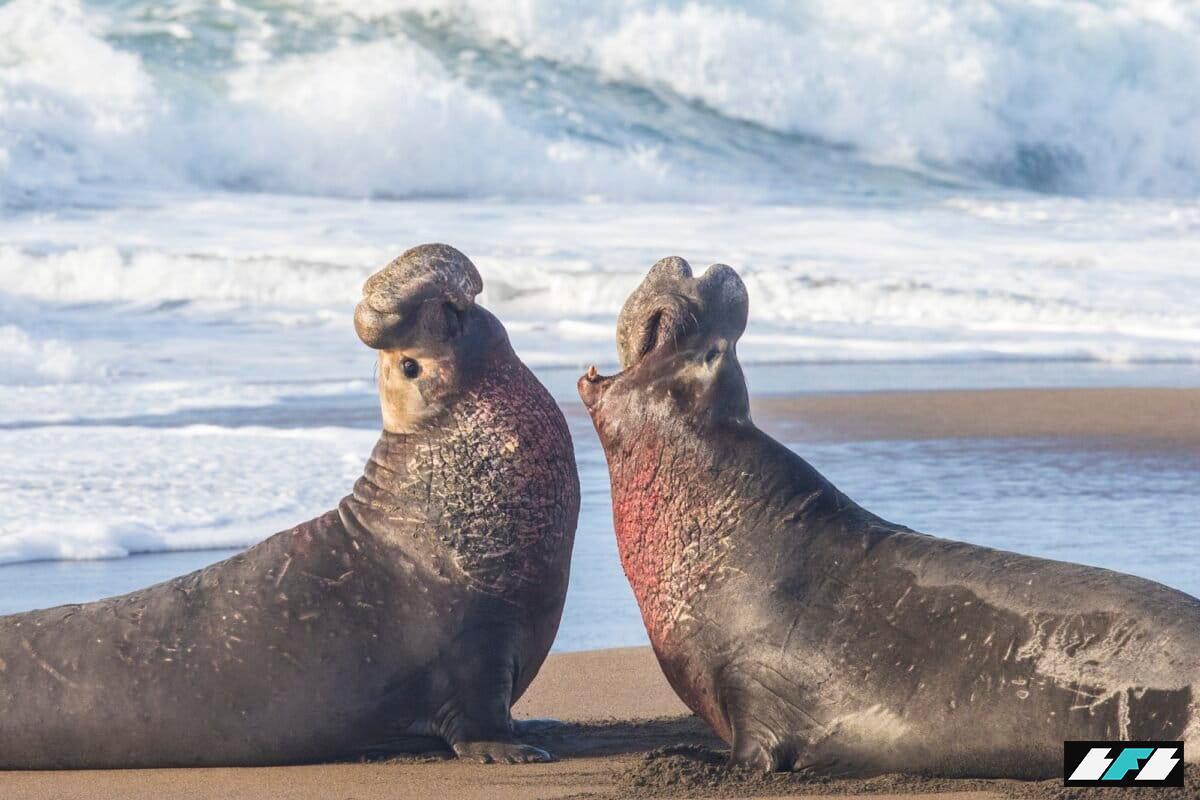
Elephant seals can recognize the voices of their rivals
Updated: April 8, 2026
Elephant seals spend most of their lives at sea, returning to shore just twice every year to molt and breed. The breeding season typically includes males weighing thousands of kilograms violently clashing with each other to compete for females. New research finds the hefty mammals remember the voices of rivals they’ve met before and retreat if they hear recordings of a more dominant seal.
“An elephant seal call is like a drumbeat and each male’s drumbeat is unique,” Carolyn Casey, a research scientist with the University of California Santa Cruz, U.S., who led the study, told Mongabay in a video call. Casey recently presented her team’s finding at a joint meeting of the Acoustical Society of America and Acoustical Society of Japan. The study will soon be submitted for publication.
Casey has been running a long-term study on elephant seals (Mirounga angustirostris) in California’s Año Nuevo State Park for 16 years. In that time, her team has collected a mountain of data on the seals, and Casey said a pattern began to emerge.
“It seemed as though males would listen to the call of a rival and then decide to attack or retreat based on the information that was contained within that signal,” she said.
In 2015, the team conducted a study that found males can recognize “their rivals within a season … deciding to attack or retreat based on that individual’s dominant status,” Casey said. The next question the researchers had was whether the pinnipeds could remember their rivals’ voices the following breeding season.
So, armed with recordings of seal calls and cataloged information on the dominance status of individuals, the team conducted an experiment: They set up speakers in the breeding area at Año Nuevo State Park, where males return each year. Researchers played recorded calls of rivals and noted the responses of certain seals.
The scientists wanted to be sure the animals were actually responding to memories and not just the tone of a voice or some other variable. So, for the experiment, they chose seven mid-ranking males that had previously known both dominant and subordinate rivals.
The seven seals “responded as we would predict,” Casey said. “They ran away from the [calls of] males that were bigger or that were dominant to them and attacked the speaker if it was [from a] subordinate.”
The researchers also played the same recordings at another breeding site, some 320 kilometers (200 miles) south, where the local males had no previous experience with the recorded individuals. The males there showed very little response to the recordings.
“It’s like me yelling, Kathy, Kathy, Kathy at you and you don’t know who Kathy is, you have no experience with Kathy,” Casey said.
The study shows that elephants seals “have long-term recognition like we do,” she added.